A gold mining operation in Tanzania’s Lake Victoria Goldfields faced a dilemma when several aging thermal cameras had stopped working, leaving gaps in perimeter coverage
How do you maintain effective monitoring across an open-pit gold mine that stretches for kilometers? From mining pits and stockpiles to haul roads, valuable assets and equipment are scattered across vast operational areas. With such an extensive perimeter, even a single camera failure can leave a security blind spot and increase reliance on manual patrols.
A gold mining operation in Tanzania’s Lake Victoria Goldfields faced the same dilemma. Several aging thermal cameras had stopped working, leaving gaps in perimeter coverage. Having a reliable security system without incurring excessive upgrade costs became a priority.
In January 2026, the mine installed a new security system that included more than 20
Raythink|Raytron Industrial thermal imaging cameras. The project strengthened the mine’s perimeter protection by combining thermal cameras with different monitoring ranges and centralized video management, while making effective use of the existing infrastructure.
Closing Monitoring Gaps Across an Extensive Perimeter
The mine’s ageing security system could not keep up with the daily security demands. Failures in the mine's existing thermal cameras left sections of the perimeter unmonitored, while conventional visible-light cameras had difficulty detecting distant targets after dark.
Thus, security personnel had to rely more on physical patrols to spot suspicious behavior especially in remote areas. These patrols cost them valuable time and vehicle resources, even if many times there were no real threats.
In addition to the physical challenges, there were also environmental factors that presented a problem. Located in an area with distinct dry and rainy seasons, outdoor equipment at the mine is exposed to dust, rainfall, and humidity.
To restore reliable coverage, Raytron Industrial supplied a combination of PC4, PC5, PC6, PD4, and FC4 Series thermal imaging cameras, configured for different monitoring distances:
- Short range: 500 m–1 km
- Medium range: 1–3 km
- Long range: 3–5 km
A custom-designed system was used to have a balance between the cost of installation and the security capability. To use only short-range cameras, additional units and mounting infrastructure would have been required, while the installation of long-range cameras in all locations would have resulted in an unnecessary increase in equipment costs.
The PC4 Series Dual-spectrum PTZ Camera was the foundation of the deployment. It is capable of detecting individuals at ranges of 1 km and vehicles up to 2.2 km away with its 1280 × 1024 thermal resolution. Each camera has an IP66 enclosure that will protect against harsh environments outside.
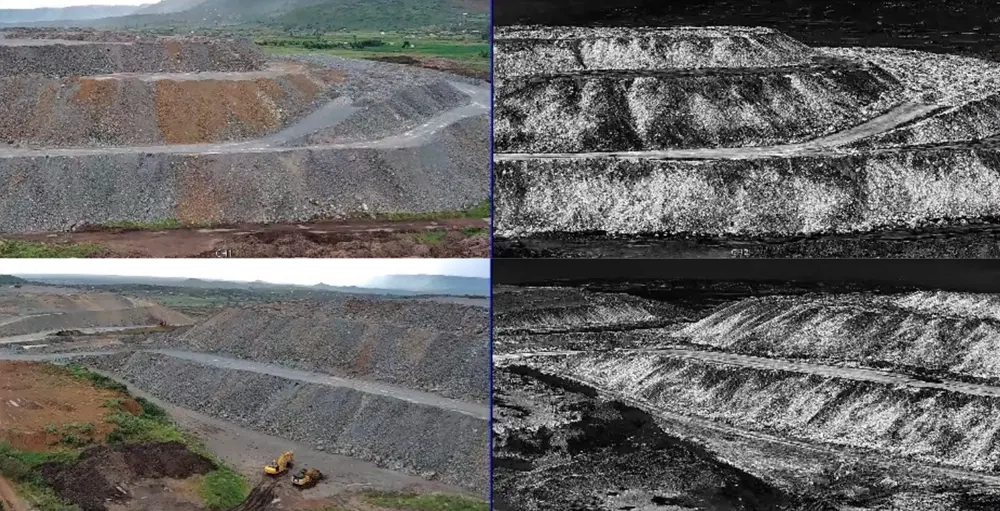 Visible-light and thermal views of mine slopes and access roads captured by the deployed surveillance system
Maximizing Coverage With Existing Infrastructure
Instead of building new mountings across the site, existing poles, observation towers, and communications towers were used in the project.
The fixed thermal cameras were mostly installed on poles, while the thermal PTZ cameras were mounted in high places, such as towers of approximately 45 meters. High installations made it possible to cover distant perimeter areas and areas that were not well covered before, at minimal additional construction costs.
All of the cameras were integrated into the mine’s existing video management platform, enabling operators to monitor remote areas using live thermal imagery from a centralized control room.
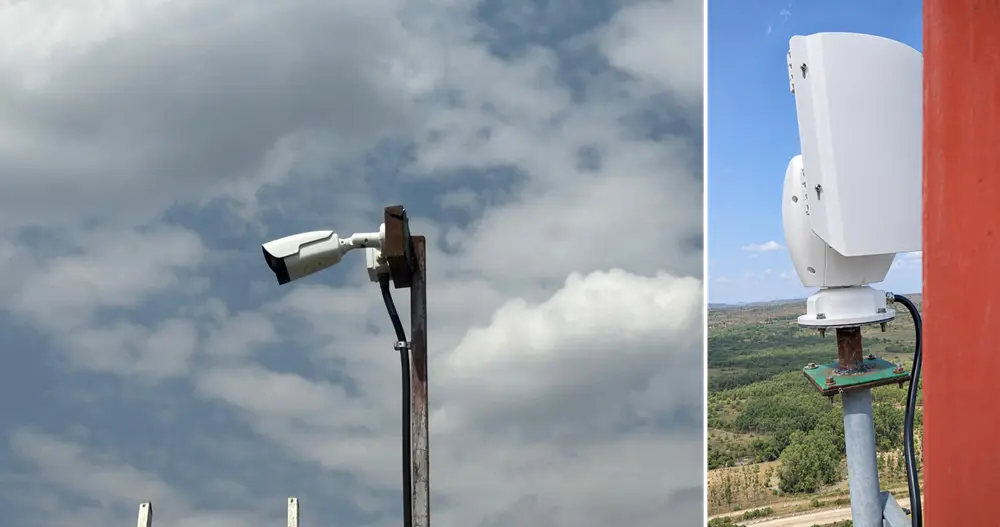 PC4 Series Dual-spectrum Thermal Camera and FC4 Series Dual-spectrum Bullet cameras installed at elevated positions
for extended perimeter coverage
From Perimeter Alerts to More Efficient Security Response
Detecting suspicious activity at a large mining site is only the first step. Accurately assessing potential threats and determining the appropriate response are equally important.
The new system will automatically generate alerts when targets cross pre-defined virtual boundaries or enter restricted zones. If an alarm is triggered, operators can view thermal and visible-light images in real time to assess the situation and decide whether to dispatch security personnel.
There are many villages close to the mine and livestock may sometimes come close to the perimeter. Operators can see live thermal and visible-light images from the control room to remotely identify a cow that has entered a restricted zone, instead of wasting time sending out a patrol for no reason.
By verifying before responding to an alarm, security organizations can minimize the number of false alarms that require the dispatch of personnel, vehicles, and fuel; this allows the security organization to concentrate its resources on responding to legitimate security threats.
Improving Operational Efficiency and Long-Term Reliability
Improving the security of the mine perimeter is expected to provide long-term financial benefits.
- Avoided theft losses: It is estimated that eight incidents of theft occur annually at a loss of approximately USD 10,000 each. Preventing 75% of these incidents would provide economic benefits of approximately USD 60,000.
- Reduced patrol costs: Eliminating 10 unnecessary patrols a week at a cost of USD 40 each would provide economic benefits of approximately USD 20,800.
- Lower maintenance costs: It is estimated that replacing the aging equipment would reduce maintenance costs by approximately USD 12,000 per year.
The total potential benefit from these measures is estimated at approximately USD 92,800.
The systems have also gained in reliability. The new cameras have been in operation since January 2026, so have been in use for about 10 months, and have resisted different environmental conditions such as dust and rain . No significant equipment failures have been reported.
Maintaining consistent perimeter coverage has enhanced the operational reliability of the mine.
Building a More Efficient Mine Perimeter Security System
The gold mine in Tanzania illustrates how the use of thermal imaging can improve perimeter security without the need to replace current security systems.
Using different types of cameras and mounting them at elevated locations allowed the mine to better control and effectively utilize its security resources.
Other mining operators have the opportunity to use thermal imaging not only to facilitate effective response to security incidents at night, but also to provide visual information to support decisions in a timely manner to enhance security across the mining operations.
Explore the Full Case Study
Discover how Raytron Industrial’s thermal imaging solutions enhanced perimeter security at a Tanzanian gold mine.
Download the full case study.
For further information:
Email:
sales@raythink-tech.com
Website:
https://www.raythink-tech.com/