Company discusses market evolution, new Full HD infrared core, and growing demand for multi-sensor integration
At Intersec Dubai 2026, Raythink demonstrated how thermal imaging technology is evolving beyond traditional intrusion detection to meet increasingly sophisticated security requirements across the Middle East and North Africa region. Nina Zhong, Middle East Sales Manager for Raythink, shared insights on market trends, customer demand shifts, and the company's expanding role in the regional security landscape.
From modules to integrated solutions
Founded in 2009, Raythink has progressively expanded its portfolio from infrared and core modules to complete devices and system-level solutions. The company's product range now spans industrial monitoring, gas detection, and both fixed-mounted and handheld devices, with strength in industrial environments and high-security applications.
The Middle East has always been a key strategic market for Raythink, with Dubai serving as the primary exhibition gateway."In the early stage, the focus was on infrared modules," Zhong explained. "We later gradually expanded to complete devices and integrated system solutions."
The company's exhibition strategy has matured alongside its market presence. "The purpose of exhibitions has gradually shifted from new customer development to maintaining relationships with existing customers and strengthening cooperation with regional distributors and large system integrators," Zhong noted. "We want to communicate that Raythink provides not only products, but also customization and technical integration services."
Market education remains a priority
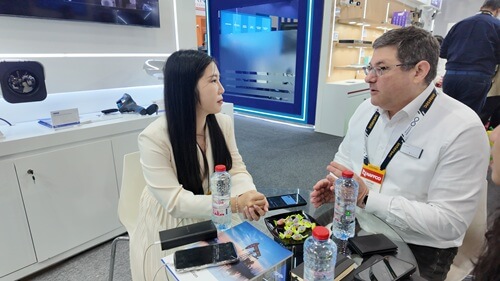 Nina Zhong (left), Middle East Sales Manager for Raythink,
speaks with Israel Gogol, Group Manager, Messe Frankfurt Taiwan Branch
Despite thermal imaging's proven capabilities, market education continues to be essential. Compared to traditional CCTV security systems, infrared and thermal imaging technologies remain relatively unfamiliar to many end users, particularly small and mid-sized system integrators.
"The key challenges include relatively higher pricing and limited understanding of infrared products and applications among small and mid-sized system integrators," Zhong acknowledged. The company addresses this through ongoing promotion and education efforts, helping customers understand both the growth potential and real-world implementation value of infrared technologies.
Pilot projects drive regional growth
Throughout 2025, Raythink completed multiple pilot projects across the Middle East and North Africa, targeting sectors where thermal imaging delivers distinct advantages: long-range monitoring, renewable energy, and petrochemical and oil and gas industries.
Application scenarios have been diverse, ranging from perimeter intrusion monitoring in oil fields to gas leakage detection and early warning systems in industrial zones and high-risk environments. These deployments have helped demonstrate the technology's practical value beyond conventional security applications.
AI transforms customer requirements
The most significant shift in customer demand has come from AI integration. "In the past, thermal imaging was mainly used for intrusion detection, including biogas early warning, hazard alerts, and safety infrastructure monitoring," Zhong explained. "Over the past one to two years, with the maturation of AI technologies, customer requirements have increased significantly."
Today's customers expect far more granular intelligence. "Customers no longer only require detection of whether a person is present," said Zhong. "They now expect simultaneous detection of humans and vehicles, vehicle classification such as distinguishing trucks from passenger cars and more advanced recognition of behaviors and actions."
Some applications have become remarkably specialized. In border and coastal security scenarios, for example, customers want systems that can detect whether a person is swimming, with identification achieved through temperature characteristics and behavioral patterns. These evolving requirements are driving continuous technology upgrades to meet market expectations.
New products address emerging needs
At Intersec, Raythink showcased its previously launched 1920-resolution Full HD infrared core, which has entered mass production and is now integrated into the company's complete system products. This higher resolution capability supports the more detailed analysis required for advanced AI applications.
The company also highlighted its heavy-duty pan-tilt units and multi-spectral electro-optical payloads, which support integration of infrared and visible-light payloads. Depending on customer requirements, radar systems can be installed on the top platform, with a stable integration structure designed to facilitate system integration for integrators.
Looking ahead
As AI and multi-sensor fusion technologies advance, customer expectations continue to rise. Zhong identified several key trends: "Customers increasingly expect more accurate object classification, lower false alarm rates, and greater cross-device integration combining cameras, radar, and AI."
While detection, identification, and intrusion monitoring remain core requirements in the security sector, Zhong sees potential for thermal imaging to expand into more applications.
With its 2025 performance in the Middle East and North Africa described as positive, Raythink appears well-positioned to capitalize on the region's growing appetite for sophisticated thermal imaging and multi-sensor security solutions. The company's evolution from component supplier to system integrator reflects broader market trends toward comprehensive, AI-enabled security platforms that deliver actionable intelligence rather than simple detection alerts.