Storage and data transmission efficiency is one of the longest-standing challenges that video security professionals face. For decades, it was an inevitable truth that increased efficiency—for example more data on the same storage device—meant data had to be compressed more aggressively, leading to a decrease in image quality.
In times of rising storage hardware prices, new technologies are offering a path toward a solution: Edge devices can use AI to distinguish between more and less information-rich areas in video images and encode every frame accordingly before the data is even being transmitted. The storage footprint shrinks, while the quality of the data that is relevant for live view, forensic investigations and evidence remains high resolution.
Hikvision’s Guanlan Encoding, one of the foremost technologies of this kind in the market, offers 30%–50% storage savings on average without compromising critical footage quality.
To gauge whether the technology is suitable for real-world deployments, asmag.com has teamed up with Hikvision for a survey of asmag readers, entitled “AI encoding technology for video security,” and asked them about their experience and where they see potential for AI encoding going forward.
In
this partner piece, we have already explored the scale of the “storage challenge” and how ready the industry is for AI-based encoding in general. Now we will shift our focus to whether AI-based encoding technologies—and Guanlan foremost among them—are trusted enough to become the new standard.
Readers see great potential with few caveats
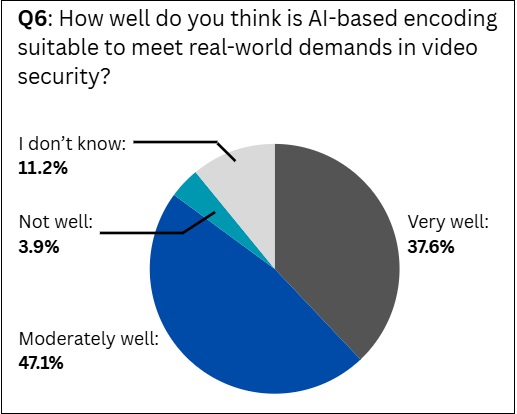
When readers were asked “How well do you think is AI-based encoding suitable to meet real-world demands?” the most common answer was “moderately well,” given by 47.1% of respondents. A significantly large share of respondents—37.6%—even see no reason for moderation and said the technology is “very well” suitable. The combined share of those who are positive about AI-based encoding dwarfed the share of those who said it is “not well-suited” (3.9%), or who said they “don’t know” (11.2%).
The reason for this seems clear: AI-based encoding is seen as key to achieving “lower storage hardware costs” and “lower bandwidth/ network load”—these two answer options were each picked by 42.6% of respondents to the question “Where do you see the most potential for AI-based encoding?”
Other answer categories picked by a significant share of respondents were “more storage on existing hardware” (37.6%) and “easier scaling with more cameras and higher resolution” (26.9%).
Even though respondents could pick up to three answers, a lower share picked the rather technical answer options referring to better “preservation of HD details” (23%) and “faster video search” (21.3%). This shows that AI-based encoding is not seen as one technological innovation among many, but veritable relief to the longstanding challenge to store data efficiently.
Big potential in large-scale verticals
When readers were asked “In which vertical do you see the most benefits?” the answers skewed toward areas where video security is deployed at a large scale. The largest share of respondents—43.8%—picked “industrial/manufacturing,” followed by “critical infrastructure” (38.7% ) and “transportation” (33.1%).
Some verticals that include many SME and small-scale users were also picked by a significant share of respondents, especially “retail” (29.7%) and “residential/smart building” (21.9%). Meanwhile, respondents were more reluctant to pick “education” (12.9%) and “healthcare” (7.8%).
High adoption bars for new standards
AI-based encoding is a genuinely new technology in a field that has long been dominated by a few well-established standards.
- H.264, first introduced in 2003, remains the most widely deployed video codec across industries.
- H.265, introduced in 2013, roughly doubles compression efficiency over H.264 at comparable visual quality.
- AV1, introduced in 2018, is a royalty-free standard developed as an alternative to licensed codecs.
As Guanlan Encoding is built as a H.265-based technology rather than as a new proprietary format, it remains interoperable with all existing decoders and third-party systems that run on H.265. Operators of existing systems using this codec can replace previously installed cameras with devices using Guanlan Encoding without seeing any operational or technical changes. The only change is that the same camera count running at the same resolution and frame rate will result in a significantly smaller data footprint.
When encoding real-life video streams, Guanlan Encoding runs two processing modes in parallel. Dynamic Sensing continuously adjusts how bits are allocated within a scene, preserving full detail on people, vehicles and other moving objects, while compressing static background elements more aggressively. Static Optimization goes further in low-motion footage, applying very high compression to frames with little to no change — in some cases reducing them to just a few dozen bytes.
Solving compatibility issues instead of adding complexity
When asked “What concerns or barriers do you see in adopting AI-based video encoding?” 38.2% of respondents cited “compatibility with existing systems”—the largest share among all possible answers. 35.9% cited “high cost of AI devices”—the second-highest share—followed by “vendor lock-in/ proprietary formats” (31.4%) in third and “unclear industry standards” (30.3%) in fourth.
This might not be surprising, as AI-based encoding only recently became available on the market. It is crucial for vendors like Hikvision to build trust among industry professionals in this early phase. Claims of seamless compatibility need to be backed up by operational reality.
However, industry professionals showed great interest in Guanlan Encoding. When asked “How familiar are you with Guanlan Encoding?” the largest share of respondents—41.5%—said “I've heard of it, but never seen it in action or tested it.” Meanwhile, the shares of those who have had more exposure to the technology and those to whom it is completely new were about equal in size: A combined 30.1% said they have “seen it in action,” “tested it,” or “used it,” while 28% said they had “never heard” of Guanlan Encoding.
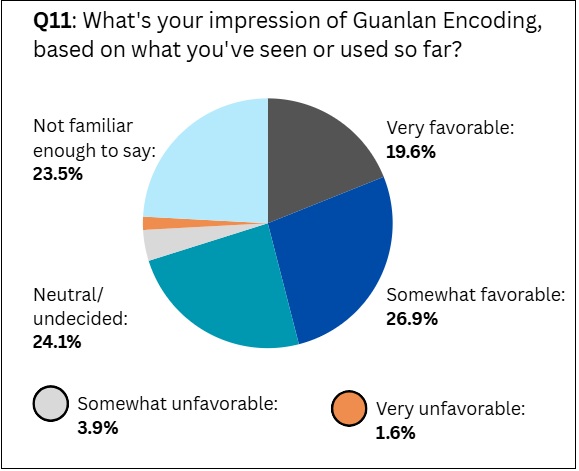
Even though respondents have had limited exposure to the new technology overall, their impression was generally positive. When asked “What's your impression of Guanlan Encoding?” nearly half of respondents expressed positive sentiment: 19.6% said their impression is “very favorable,” while 26.9% answered “somewhat favorable.”
The contrast is especially stark when compared to those who said they see Guanlan Encoding “somewhat unfavorable” (3.9%) or “very unfavorable” (1.6%). Another large group of respondents—47.6% combined—said they are “neutral/undecided” or “not familiar enough to say.”
Over half are ready for Guanlan Encoding
Widespread willingness to consider Guanlan Encoding comes as no surprise—given the severity of the storage challenge, the technical benefits of Guanlan, its seamless compatibility and the prospect of saving 30%-50% storage without compromising critical footage quality.
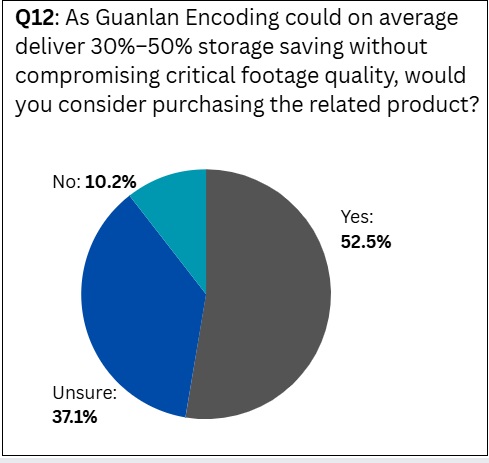
When asked whether they would consider purchasing a product using Guanlan Encoding, a robust majority of 52.5% said “yes,” while only a small minority of 10.2% said “no.” The fact that another large group of 37.1% remain “unsure” as to whether they would purchase a Guanlan Encoding product shows how serious industry professionals are taking the issue, but it also shows that Hikvision’s new technology has the potential to win over an even larger share of industry professionals.
When respondents were given the opportunity to express their thoughts on AI encoding in their own words, most were positive, but many also expressed the need to assess such a consequential new technology in depth and understand how it performs in real-world conditions.
Or, as one survey respondent (a dealer/distributor from Bulgaria) put it: “The Hikvision material about Guanlan looks good but I want to wait until I see some independent data on bandwidth saving."
Read our partner piece to find out in which scenarios and verticals AI-based encoding is seen as especially suitable, where respondents see potential adoption barriers, and how they assess Guanlan Encoding. Find more reporting about the “AI encoding technology for video security” on
the dedicated landing page on asmag.com, or download the
full results of the survey.