Video security has seen many innovations in recent years, from the emergence of AI to higher-resolution recording and deeper AIoT integration in business operations. Most innovations—and foremost among them those enabled by AI—have in common that they generate large amounts of data, which drives demand for more bandwidth and storage.
In real-life scenarios, this has led to the emergence of a significant pain point: How can operators navigate tradeoffs between wider AI adoption and increasing infrastructure costs? One of the most significant approaches to solving the issue is using AI itself to reduce the data footprint of AI-enabled systems. In video-centric systems, this means encoding the full wealth of information in smaller amounts of data.
Hikvision has therefore developed Guanlan Encoding, a technology that uses AI to identify more and less information-rich areas in video images and encodes every frame accordingly.
To gauge the potential impact of the new technology, asmag.com and Hikvision have teamed up for a survey of asmag readers, entitled “AI encoding technology for video security,” and asked them about their experience with the “storage challenge” and where they see potential in their projects for AI-based encoding.
A total of 178 physical security professionals took part in the online survey from August 4 to 25, 2026, after receiving invitations by email, through social media and the asmag website.
While this article focuses on the scale of the storage challenge and how ready the industry is for AI encoding as a potential remedy,
this partner piece focuses on whether AI-based encoding is trusted enough to become the new standard.
Storage pressure is real and growing
When asked “How significant a challenge is video storage cost or capacity in your business or projects?” a large amount of respondents—38.2%—identified storage pressure as a “major challenge.” It was the second-most given answer among all respondents, trailing closely behind 43.2% who said storage is a “moderate” challenge.
With 16.8% saying they encounter storage pressure “occasionally,” only a marginal group of 1.6% said storage is not a challenge.
While the overall sentiment about the significance of the storage challenge was between “major” and “moderate,” the picture was similar when readers were asked about how the issue has developed over time.
When asked “Has the storage challenge changed compared to 12 months ago?” the largest share of respondents—once again 43.2%—said it has “increased moderately.”
For about one quarter of respondents—25.2%—the challenge has even “increased significantly,” while another quarter—25.0%—said the challenge has “stayed the same.” Meanwhile the group who sees improvement remained small, with 6.3% of respondents seeing a “moderate” or “significant” decrease in the severity of the storage challenge.
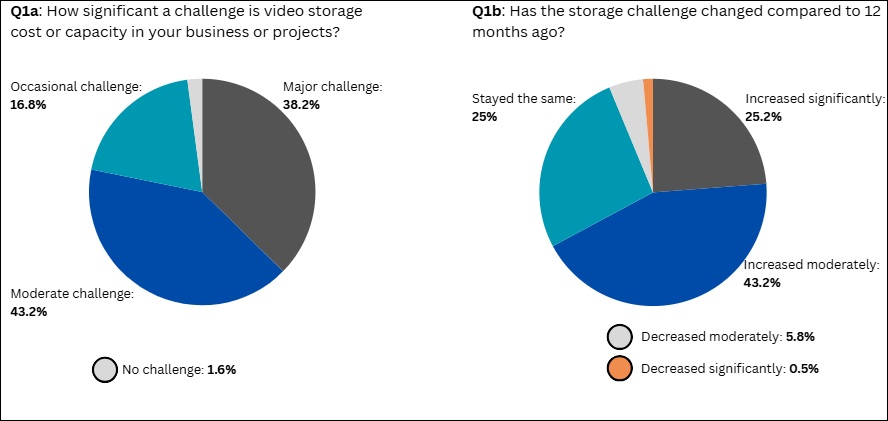
Overall, the picture is clear: Storage pressure impacts every part of the industry, making solutions to address it an urgent development focus for vendors.
Hardware prices as the main culprit
When asked “What are major drivers of storage pressure in security projects?” over half of respondents—52.8%—identified “rising storage hardware prices.”
When answering this question, respondents could pick up to three options, and the ones that followed “hardware prices” in second and third complemented the picture: 39.8% picked “growing numbers of cameras / larger deployments,” followed narrowly by a “shift to higher-resolution footage,” which was picked by 39.3%.
The trend is clear: More data and more expensive data storage coincide in driving the trend identified in the first two questions. Other drivers, however, are playing a role, too: “Bandwidth and network constraints” were picked by 29.7%, while 26.9% picked “longer retention periods and compliance rules,” and 15.1% picked “cloud storage costs.”
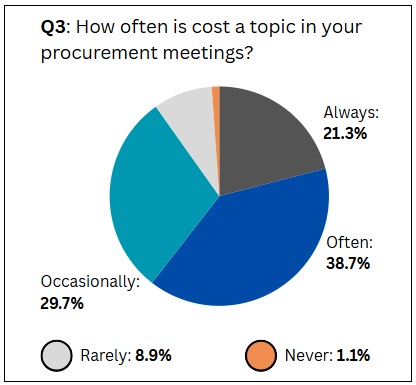
Unsurprisingly, the storage challenge often plays a role in procurement meetings at the employers of asmag readers. When asked about the frequency of the issue coming up, the most common answer was “often,” picked by 38.7%. Meanwhile, 21.3% said storage is “always” a topic and 29.7% said it comes up “occasionally.”
Guanlan Encoding—Hikvision’s solution to a growing pain point
Guanlan Encoding, which Hikvision introduced in May 2026, is built on the H.265 standard and integrates the company's Guanlan Large-Scale AI Model into continuous encoding workflows. Rather than compressing every part of a frame equally—the approach traditional codecs take—Guanlan Encoding identifies which parts of a scene matter most, such as people, vehicles and other moving objects, and allocates more detail to them. Static or low-motion background footage, by contrast, is compressed far more aggressively.
According to Hikvision, this combination of different compression rates in the same frame helps reduce storage needs by 30% to 50% on average without sacrificing details that matter for investigations and monitoring.
As Guanlan Encoding is built as a H.265-based technology rather than as a new proprietary format, it remains interoperable with all existing decoders and third-party systems that run on H.265.
Survey respondents indicated great familiarity with H.265, with 61.5% saying they are using it and 31% saying they are familiar with it. For operators of H.265-based systems, nothing changes operationally or technically—except that their storage pain point is alleviated with every new camera using Guanlan Encoding that replaces an older model.
Guanlan is already gaining ground
Even though it was introduced so recently, over half of survey respondents expressed familiarity with Guanlan Encoding: 43.3% said they are “familiar with it” despite not yet having hands-on experience, while 8.3% said they are already using the technology.
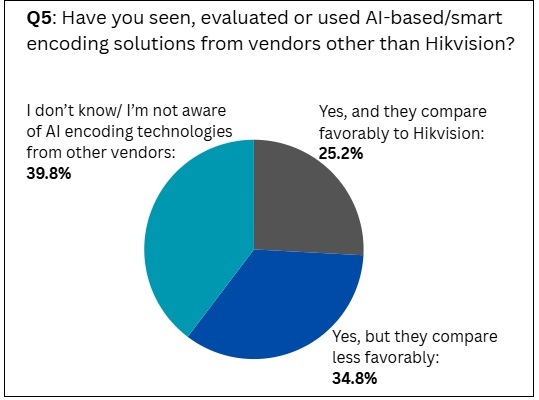
When asked to compare Guanlan to AI-based encoding technologies by other vendors, respondents expressed great trust in Hikvision: 34.8% said Guanlan compares favorably, while 25.2% said they are preferring other technologies. Even though the largest group—39.8%—said they aren’t familiar enough with AI encoding to give an answer, Hikvision already has a favorability gap of nearly 10 percentage points in its favor.
Overall, the survey showed the severity of the storage challenge, but also that Hikvision is well positioned to offer a significant fix to the pain point. Guanlan Encoding plays a key role as it uses AI not to produce more data, but to reduce the burden of more data on storage infrastructure.
Read our partner piece to find out in which scenarios and verticals AI-based encoding is seen as especially suitable, where respondents see potential adoption barriers, and how they assess Guanlan Encoding. Find more reporting about the “AI encoding technology for video security” on
the dedicated landing page on asmag.com, or download the
full results of the survey.