Video systems have been transformed since Hikvision launched its Guanlan large-scale AI models in 2025. Today, detection is far more accurate, with far fewer false alarms; video costs far less to store; and system interaction and video retrieval are now driven by natural language.
It’s over a year since Hikvision launched the Guanlan large-scale AI models. In a very real sense, today’s video systems ‘understand’ what they are looking at. They also know what has already been recorded and, thanks to the natural language innovations, what the user wants. These are the things that let a product fit the scenario it is deployed in – delivering operations that run more safely, at lower cost, and with less manual work.
What is Guanlan?
Guanlan is Hikvision’s proprietary suite of large-scale AI models. It is the AI foundation behind the company’s shift from traditional video security to AI-powered Internet of Things (AIoT) solutions.
These are models designed to work across computer vision, multidimensional perception, and multimodal fusion – combining text, video, audio, and other inputs for AI reasoning.
The name originates from one of the Chinese classics,
the Book of Mencius: to understand water, one must observe its waves. Similarly, Guanlan perceives hidden patterns by knowing exactly where and how to look.
Guanlan starts with foundation models – large IoT perception models spanning vision, fiber-optic, audio, X-ray, and millimeter-wave, alongside large language and multimodal models. These are further trained with industry knowledge and operational know-how, adapting general-purpose capabilities to domains such as industrial safety, store operations, traffic management, and infrastructure inspection.
AI detection and analysis: Alarms you can count on
Traditional analytics struggle with complex scenes. By drawing on broad pre-trained capabilities, a Guanlan AI model significantly reduces false alarms and missed events. This allows the system to extend its accurate detection into specific behaviors and complex environments – helping users proactively mitigate risks across various scenarios.
Perimeter protection
The perimeter is where a wrong detection costs most. Legacy systems are easily triggered by animals, weather, and moving vegetation, burying real threats under manual assessment work.
Guanlan addresses this problem at the edge. DeepinViewX cameras run the model, cutting false alarms by 90% while detecting at twice the range of traditional cameras, with half as many repeated alarms on the same target. Whether using optical cameras for short perimeters, or thermal, radar, and fiber-optic sensing for vast distances, the AI helps reduce the noise.
Scenario-specific analytics
Beyond the perimeter, Guanlan moves past standard object detection to flag high-risk issues in specialized environments. Built for recognized operational risks, these applications typically reduce false alarms by 70% to 90%.
Safety & compliance: Examples include Personal Protective Equipment (PPE) detection on construction sites, fall detection in care homes, and smoking detection in gas stations. In all cases, the system continuously monitors for risky behaviors and triggers instant alerts.
Operational hazards: Examples include forklift detection in logistics parks, and early fire and smoke detection in mining sites using dual-channel thermal cameras.
Specialized uses: Examples include animal detection for large farms and prohibited item detection at transport hubs – the latter powered by large X-ray and millimeter-wave models.

The list of detections keeps growing. With large AI models, adding a new capability takes far less data than before. Based on lab testing, Guanlan-powered AI applications require up to 90% fewer training samples than conventional AI models. This efficiency makes uncommon requirements worth answering, while Hikvision's AI Open Platform (AIOP) allows users and partners to train their own algorithms for scenarios not covered on the built-in list.
AI efficiency engine: Doing more with less
Guanlan's intelligence extends beyond accurate detection; it acts as an efficiency engine that fundamentally optimizes how systems manage storage and retrieve information. By lowering operational costs and minimizing response times, it makes the entire video infrastructure more agile.
Saving storage with intelligent ROI compression
Conventional encoding treats every part of the frame as equally worth keeping. To deliver breakthrough video storage optimization,
Guanlan Encoding brings the large vision model into the encoding pipeline. Before compression, AI reads what is in the frame and separates the areas that carry valuable information from the ones that repeat. It uses precision Region of Interest (ROI) segmentation to preserve detail on dynamic subjects – people, vehicles, and other key objects – while applying heavier compression to static backgrounds.
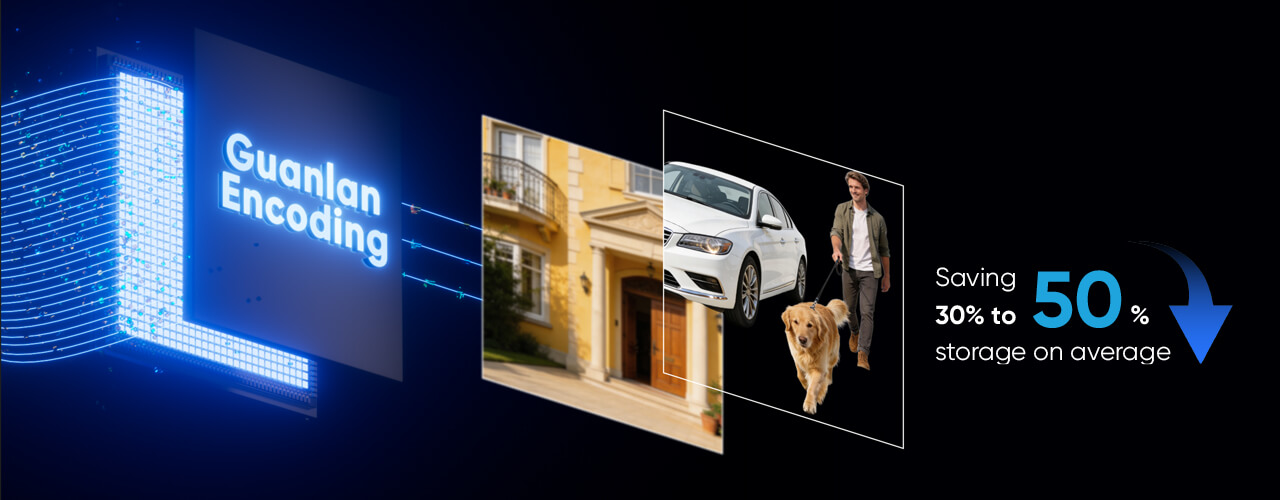
Storage savings average between 30% and 50%. On a 2,000-channel project recording 1080p at 2 Mbps for 90 days, HDD requirements can be reduced from 403 to 202 units, with close to half the rack space saved as well, and less pressure on network bandwidth. Importantly, Guanlan Encoding works within the H.265 international standard, so its output remains seamlessly interoperable with compliant third-party devices.
Searching video with just a few words
Finding a specific moment in recorded video has often been slow. An operator knows roughly what they are after and has no way to pinpoint it except by scrubbing a timeline.
AcuSeek removes that step. Built on a large multimodal model for natural language video search, it aligns image features with the meaning of a written phrase, so a description becomes a query. Results come back in seconds. The system recognizes far more than the usual categories. Beyond just people, vehicles, and two-wheelers, it understands specific objects and details: “wheeled luggage,” “a shopping cart,” “a white dog,” or “an e-bike rider without a helmet.”
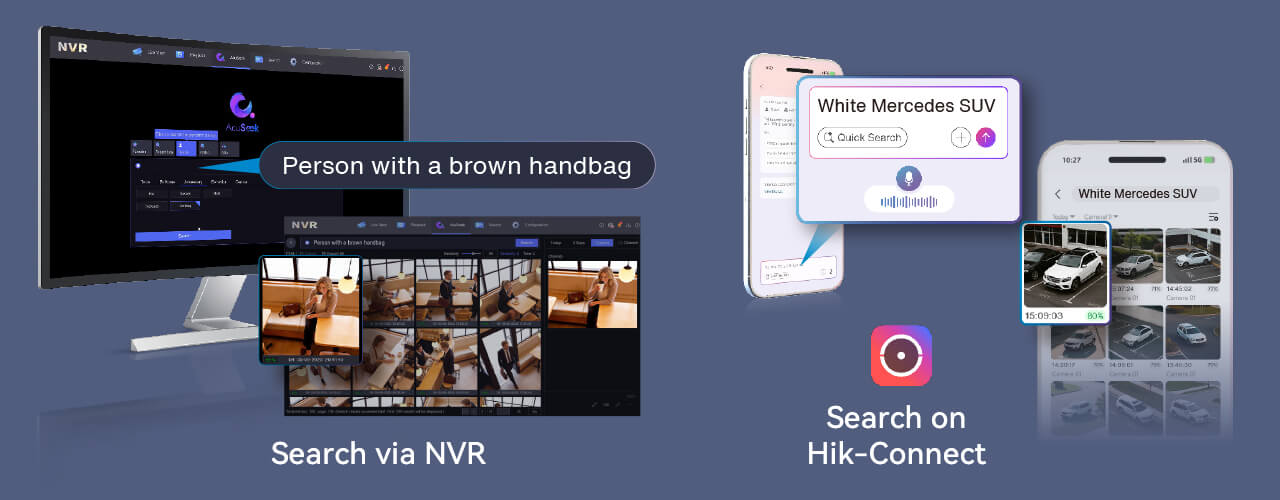
Operation is deliberately simple. Searches run on the recorder, or remotely through the Hik-Connect app and HikCentral Professional, where they can be narrowed by time and location. Voice input works alongside text, and the system understands more than 30 languages.
Furthermore,
OpenAlert shifts this capability from reactive search to proactive monitoring. Describe a target in text, such as “a person pushing a cart” or “a man holding a box,” and the system raises an alert the next time one appears. It is ideal for scenarios where real-time alarm delivery is not a priority.
AI in action: Industry applications
The previous sections have covered a variety of Guanlan AI applications. This section explores how Guanlan AI is fine-tuned to solve specific industry challenges, using retail and traffic management as examples.
Retail
A store’s bottom line is drained just as easily by a missed sale as by a stolen item. While AI continuously tracks shelf fullness with a preset threshold and reminds staff to refill, Guanlan’s most immediate impact is on stopping unpaid exits across the floor.
Two classic examples are concealment and cart theft. With
concealment, an item typically goes into a bag, a pocket, or under a coat. A Hikvision server analyzing the video stream flags the action as it happens, so security is told while the person is still in the store.
Stolen shopping carts represent a persistent operational cost for many retail stores. AI, running on a DeepinMind NVR, can monitor designated return areas for virtual line crossing, instantly pushing alerts to HikCentral Professional when carts leave the return area.
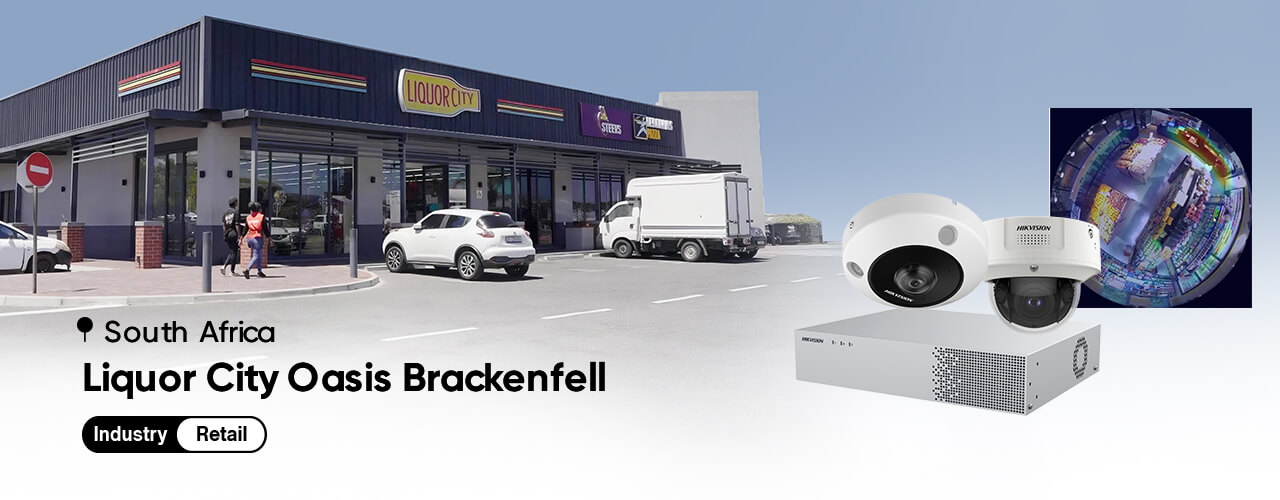
At Liquor City’s Oasis Brackenfell store in South Africa, the same Guanlan-powered analytics run continuously on the shop floor, and the store manager reports better planning, faster service, and reduced loss.
Watch the story video to see this in action.
Traffic
Monitoring traffic is notoriously challenging. After all, a road scene is full of things that resemble the thing operators are looking for. For example, from the camera’s angle, a light pole may resemble a fallen object on the highway; a roadblock may resemble a stopped vehicle; and vehicle lights at night might resemble pedestrians. Look more closely inside vehicles and the problem repeats, albeit in a much smaller frame. Seatbelts, for example, can be close in color and shape to the driver’s clothing, and a hand raised near the driver’s head is not necessarily holding a phone.
Because they read the full scene rather than the object in isolation, Guanlan Automatic Incident Detection (AID) products are able to recognize more than 16 road event types and cut false alarms by 60%. Checkpoint cameras recognize more than 20 violation types and cut false detections of phone use and seatbelt violations by 75%, while urban road ANPR cameras reach 95% accuracy on vehicle color, type, and make.
Detection is only half the equation, however. Using multidimensional perception data like vehicle flow, average speed, and queue length, the system moves beyond rigid, fixed-time schedules to AI-powered adaptive signal optimization, coordinating green waves across sequential intersections so traffic keeps moving.
A great example is Bonifacio Global City in the Philippines, where that adaptive control is implemented across 46 intersections, cutting average intersection delays by 19.6% and raising morning peak speeds by 20.2%.

The next frontier: Software as an AI agent
Whether securing a retail floor or optimizing a traffic network, these AI applications excel at delivering precise intelligence. Traditionally, the system stops there – it hands the user a cleaner alarm or a faster search, and the user takes it from there.
But that paradigm is shifting. Video software is beginning to interpret what it sees, answer in plain language and, in some cases, act on what it finds.
This is where Hikvision’s new
HIKO AI agent, arriving on the HikCentral Professional platform and Hik-Connect app, changes the interaction entirely. It sits between the system and the user, turning complex configurations into simple conversational commands.
HIKO acts as an
AI Assistant that carries out administrative instructions instantly – like setting up visitor access against a plate number or pulling an attendance report just by asking for it. It functions as an
AI Guardian, replacing rule configurations with a natural language command (e.g., “Alert me when the passageway is blocked”), tagging each alarm with a written summary, and composing contextual audio warnings from the scene. Finally, as an
AI Search engine, it reconstructs a person's complete movement path – across video, door records, and ANPR reads – simply because the operator asked, “Where did the man in the blue shirt go?”
Ultimately, Guanlan strives to provide
real-world insights for every industry to transform the efficiency and cost-effectiveness of solving operational challenges. Detection takes less time to review, new capabilities take less data to train, and archives take seconds to search. And now, the answer is starting to arrive as a summary, a smarter warning, or an action already taken. For anyone running these systems, the future is clear: the question has fundamentally shifted from what can a device detect to what you would ask it to look for.
Find out more
To find out more about how Hikvision’s Guanlan AI capabilities would look like on your sites, contact Hikvision or your local distributor.
FAQs
How does Guanlan differ from conventional AI video analytics?
Guanlan evaluates complex scenes using large-scale AI models and pre-trained industry knowledge. In practice that means 70% to 90% fewer false alarms than conventional AI video analytics, and a new capability needs up to 90% fewer training samples to build.
What if the detection we need is not on the list?
Then it can be built. Hikvision's AI Open Platform (AIOP) lets users and partners train an algorithm for their own use case and import it to an AIOP-enabled camera or recorder, extending detection to scenarios the built-in algorithms do not cover.
Where do the Guanlan models actually run?
Wherever the problem is. Most detection models run on the edge, inside the camera. Others run on back-end hardware such as NVRs and servers, which is how a site keeps its existing cameras and only upgrades the back end to add analytics. And not all of it is about video: prohibited item detection leverages X-ray or millimeter-wave models running on security inspection systems.
Will Guanlan Encoding cause compatibility issues with my existing VMS or storage?
No. Guanlan Encoding produces standard H.265 output. The model decides how bitrate is distributed inside the frame – detail on people and vehicles, heavier compression on static backgrounds – but the resulting stream is H.265. Any VMS, decoder, or storage system that already handles H.265 handles this too, and storage falls by 30% to 50% with no change anywhere downstream.
Does AcuSeek only work in English?
No. AcuSeek understands more than 30 languages, by text or by voice, so an operator can search in the language they normally work in. Searches run on the recorder itself, or remotely through the Hik-Connect app and HikCentral Professional platform.
Can AI Search cover access control and ANPR as well as video?
Yes. For a specified person or vehicle, AI Search covers video, door records, and ANPR plate reads in one pass, reconstructs the movement path across cameras and access control systems, and lays it on a single timeline.