Reolink is mostly known as a smart home brand, but as the company is broadening its portfolio to include solutions with competitive performance specs for business needs, retailers and other professional customers are listening up, too. To talk about changes in the market and how Relink is addressing them, asmag sat for an exclusive interview with Michael Rief, Country Director, Reolink Germany.
asmag: Reolink began as a consumer-focused smart home camera brand and has expanded considerably in Europe. How would you describe Reolink’s current position along that journey?
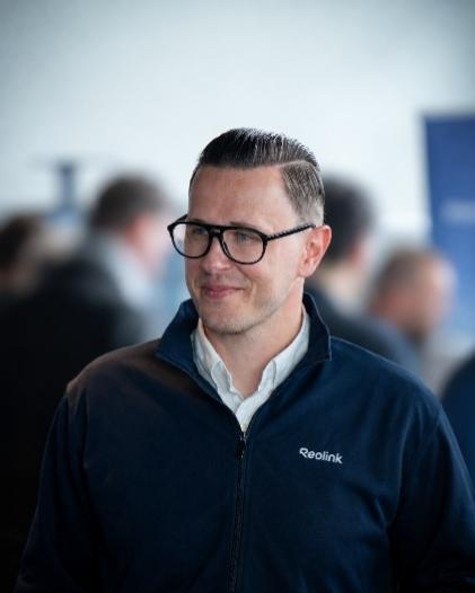 Michael Rief, Country Director, Reolink Germany
Michael Rief:
Reolink’s roots are in the consumer market, but we are seeing increasing demand from business customers and are broadening our offering to serve new sectors. Our growing European presence now covers markets such as Germany, Austria, Switzerland, France, Italy, Spain, Benelux, Poland and Hungary. We have also expanded from selling through our website and Amazon to a multi-channel approach that includes major electronics, outdoor and DIY retailers.
Creating more touchpoints with the brand gives customers more opportunities to explore our products and buy through the channels they prefer. It has also increased brand visibility and strengthened our position in the European market.
Europe is a key focus for Reolink, and we see strong potential for further growth as we continue to expand our retail and distribution network and tapping into new segments like the SME sector with our Professional Series.
asmag: The value proposition of smart home security cameras has moved beyond specs such as pixel counts. What really matters today in terms of usability is ‘do cameras enable 24h per day surveillance,’ and ‘do they notify the user in real time if something happens that isn’t supposed to.’ How does Reolink approach such challenges?
Michael Rief: Expectations of a camera’s features and capabilities vary across different user groups. This is why our approach starts with individual customer needs. Our Home Security Consumer Index* shows that a majority of consumers value reliable, easy-to-use cameras, with person detection and fewer false alarms among their priorities.
For users who prioritize convenience, battery-powered cameras with solar charging can offer a straightforward solution. More technically experienced users may want continuous recording, advanced features and the flexibility to integrate additional cameras into their existing security systems. They may prefer PoE cameras and NVRs, which allow them to manage recordings centrally and customize settings to their requirements.
Business customers may need capabilities beyond video monitoring, including analytics that help them understand activity on their premises and optimize business processes. Our portfolio addresses these different requirements through a choice of camera features, connectivity and storage options.
Customer feedback also guides our AI development. ReoNeura AI supports more accurate detection and tools such as Local AI Video Search, which lets users find relevant clips using natural language. Our focus is on practical features that make security easier to manage and help customers get more value from their systems.
asmag: Smart home security cameras can give users an overview of what’s going on around their home or focus on decisive spots such as entrances, but often fail to do both at once. How does Reolink approach this issue, for example with devices such as the latest OMVI X16 PoE?
Michael Rief: Blind spots are a key challenge, particularly when monitoring larger areas or tracking moving subjects. Fixed-view cameras provide an overview but can lack detail when users need a closer look. Tracking cameras can follow a subject but may miss events elsewhere as the lens moves. Customer feedback highlighted the need to address both requirements together.
This is why we introduced the OMVI Series, with the OMVI X16 PoE as our latest flagship camera. It combines a 16 MP dual-lens panoramic bullet camera, which blends two images into a single 180-degree view, with a 4K (8 MP) pan-tilt-zoom (PTZ) camera offering 16x optical zoom.
The panoramic camera maintains the overview while the PTZ camera follows a person, vehicle or animal, allowing users to track specific events without losing sight of the wider scene. Where the panoramic view does not cover the entire property, users can also direct the PTZ camera to monitor a separate area for additional coverage.
Smart features complement this setup for ease of use. With SyncTrack, the PTZ camera automatically locks onto and follows a person, vehicle or animal detected by the panoramic camera – even after the subject leaves the panoramic view. During tracking, optical zoom is used to magnify the target in real time while keeping it centered in frame. Pinpoint also lets users click or tap a location in the dual-view screen to direct the PTZ camera there for a closer look.
asmag: Video security systems originally designed for residential use are frequently used by SMEs, for example retail shops. Reolink is meanwhile making the move into the professional space. Where do you position your professional systems between the simplicity of plug-and-play home security and the complexity of systems that are only available to SMEs through the professional channel?
Michael Rief: Many SMEs require more advanced security than typical residential solutions, but without the complexity and cost of enterprise systems. They need reliable recording, intelligent detection, easy management and scalability, often with limited IT resources.
This is where Reolink creates value. Our Professional Series combines the ease of use of our consumer portfolio with the advanced capabilities required for commercial applications, such as more advanced AI solutions and upgraded hardware. We support both self-installation and professional deployment through installers and system integrators, depending on customer needs.
For us, professional security is defined by performance, reliability and functionality not by complexity.
asmag: Scaling is of some importance for residential users, but more so for SMEs, who might also need to integrate their video security with existing systems, such as alarms or access control for employee time attendance. What is Reolink offering in this regard?
Michael Rief: As security requirements grow, customers need solutions that can scale and integrate with their existing infrastructure. Reolink offers flexible configurations, from standalone cameras to multi-camera installations with NVRs, allowing customers to expand their systems as needed.
Interoperability is equally important. Depending on the product, Reolink supports established protocols such as ONVIF and RTSP for compatibility with third-party video management systems. For advanced integration needs, we provide API documentation for select camera models. Some cameras in our Professional Series also feature alarm inputs and outputs for connecting compatible external devices and alarm systems. In addition, the Reolink Open Platform supports remote management and integration with third-party platforms. Our focus is on providing scalable, flexible solutions that meet the evolving needs of professional users.
asmag: How is Reolink positioned in Germany, Austria and Switzerland? What do customers there expect, for example on data protection, installer involvement and sales channels, and how does that shape your approach?
Michael Rief: The DACH region is a key market for Reolink, where customers place particular importance on data privacy, security, reliability and cost efficiency. Our portfolio is well aligned with these expectations, offering local storage solutions without mandatory cloud subscriptions.
We have significantly expanded our sales and distribution network, establishing strong partnerships across the region. In Germany for example, Reolink has become a leading brand in the consumer security camera market.
Building on this position, we are expanding our professional business through specialized distribution partners, ensuring installers and system integrators receive the technical expertise and support they need.
asmag: Looking ahead two to three years, what developments do you expect to matter most for Reolink? Will accessible plug-and-play systems become so technologically advanced that they can serve the needs of ever more professional users?
Michael Rief: We see two major trends shaping the video security market: AI-driven innovation and the increasing accessibility of professional-grade security technology.
AI will make security systems smarter, moving beyond basic detection towards better event understanding, proactive alerts and more intuitive operation. At the same time, technologies once reserved for complex professional systems are becoming more accessible and affordable. This will allow increasingly sophisticated plug-and-play solutions to address a broader range of commercial applications, particularly in the SME segment.
For Reolink, the opportunity is to make advanced security technology available to more customers without compromising on reliability, functionality or ease of use.
*Quantitative survey of 6,014 people in Germany (28%), France (23%), Italy (20%), Spain (16%) and Poland (12%), commissioned by Reolink and conducted in April and May 2026. Respondents were predominantly aged 35–64, with an even gender split.