Protecting an airport requires more than securing its entrances. Extensive perimeter boundaries, restricted areas, and valuable aviation assets demand continuous monitoring, particularly during nighttime operations when conventional visible-light cameras may struggle to detect activity at a distance. Effective airport security therefore depends on the ability to identify potential threats across large outdoor areas.
At
Tashkent-Humo International Airport in Uzbekistan, Raytron Industrial is helping address these challenges.
Nine PC4 Series Dual-spectrum Thermal PTZ Cameras have been deployed along the airport perimeter, providing security personnel with long-range monitoring capabilities and improved visibility across designated boundary areas.
Securing an Extensive Airport Perimeter
Located in Uzbekistan's capital, Tashkent-Humo International Airport (formerly known as Tashkent-Vostochny Airport) serves business aviation and government flights. The airport covers approximately 561 hectares and features a four-kilometer runway, aircraft aprons, and hangars accommodating different aircraft types.
Protecting this infrastructure presents several challenges. The airport's extensive grounds require continuous perimeter monitoring to detect potential intrusions early and prevent unauthorized entry into restricted zones.
The airport already employs multiple physical security measures, including perimeter walls, razor-wire fencing, security checkpoints, patrol routes, and perimeter lighting. However, these conventional measures have limitations.
Security patrols provide essential on-site protection but cannot maintain uninterrupted observation of every boundary area. Likewise, visible-light security cameras depend on adequate illumination, making it more difficult to identify potential intrusions in poorly lit areas or at long distances.
Seasonal conditions introduce additional operational considerations. Tashkent experiences hot summers and cold winters, making reliable outdoor monitoring important throughout the year.
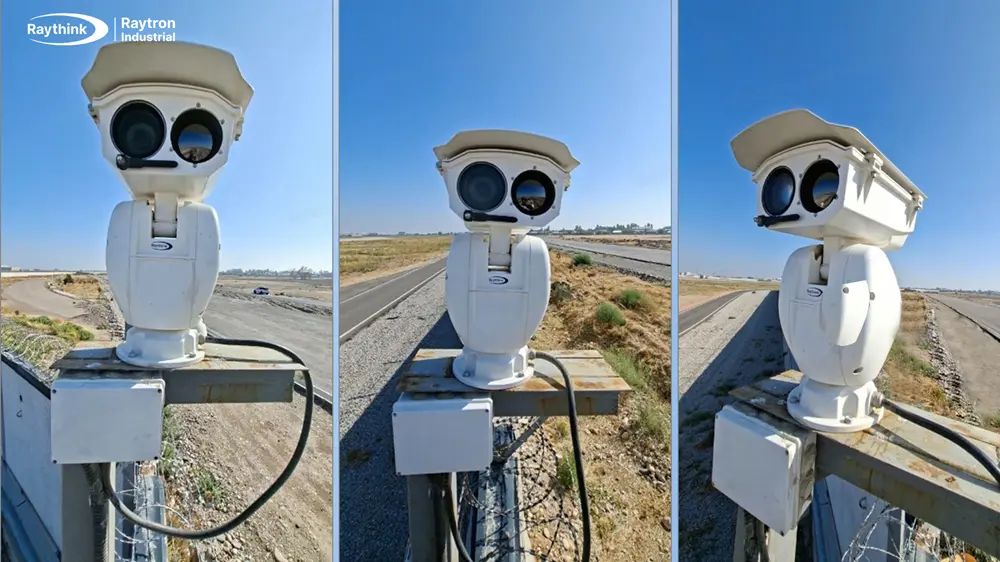 With IP66-rated dust and water protection, the PC4 Series is built for outdoor perimeter monitoring in environments exposed to dust and changing weather conditions.
The airport therefore sought to strengthen its existing airport security infrastructure with a reliable solution capable of supporting continuous monitoring, early detection, and remote visual verification.
Combining Thermal and Visible-Light Imaging
To improve perimeter visibility, the airport installed nine
Raytron Industrial PC4 Series Dual-spectrum Thermal PTZ Cameras at selected locations along its boundary.
The cameras are mounted on elevated metal brackets above perimeter walls and razor-wire fencing, providing unobstructed views of designated monitoring areas.
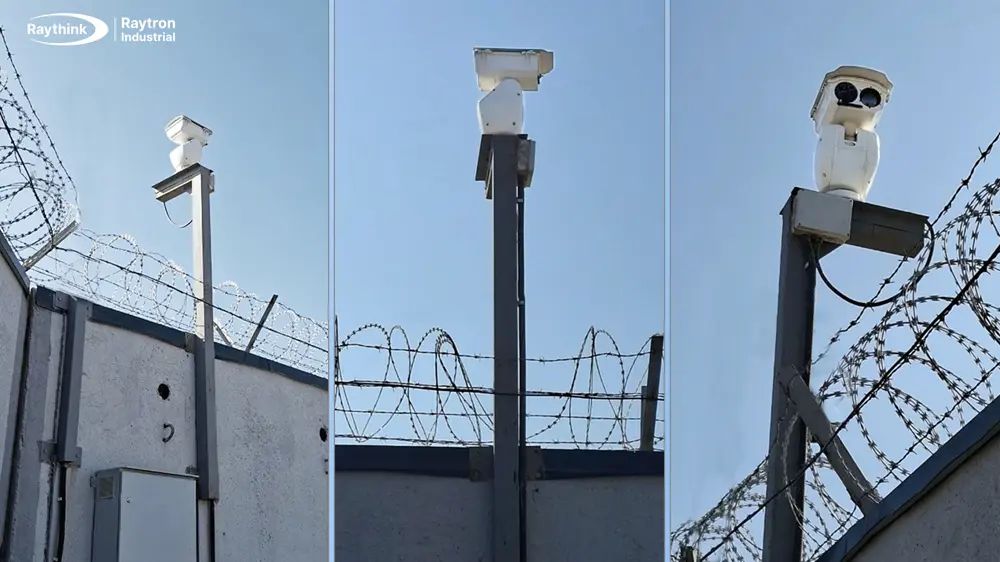 On-site installation of Raytron Industrial PC4 Series Thermal PTZ Cameras at Tashkent-Humo International Airport
Each PC4 camera combines a
1280 × 1024 thermal imaging channel with a
4 MP visible-light camera, allowing security personnel to observe the same area using two complementary imaging technologies.
Thermal imaging detects temperature differences rather than relying on visible illumination. This makes it particularly valuable for identifying people and vehicles in darkness or areas with insufficient lighting. The visible-light channel provides additional scene details that can assist operators in examining and verifying detected activity.
The PC4 Series supports
continuous 360° horizontal rotation and a tilt range of −90° to +40°, allowing operators to adjust viewing angles and monitor surrounding perimeter areas with greater flexibility. This wide range of movement helps reduce blind spots and allows operators to remotely adjust the camera's viewing direction.
Depending on the monitoring configuration and site conditions, each camera provides a coverage distance of up to
1.5 kilometers, supporting long-range monitoring across designated sections of the airport boundary.
Supporting Earlier Intrusion Detection
Beyond its dual-spectrum imaging capabilities, the PC4 Series supports intelligent video analytics designed for perimeter security applications.
These capabilities include virtual tripwire detection, area intrusion detection, and human and vehicle classification. They can help security teams identify activity that may require attention and distinguish relevant targets from other movement around the airport perimeter.
For example, when suspicious movement is observed near a restricted boundary, operators can use the cameras' thermal and visible-light channels to examine the area remotely and obtain additional visual information.
This combination of long-range imaging, PTZ control, and intelligent detection supports a more proactive approach to perimeter security.
Importantly, the thermal cameras complement rather than replace the airport's existing physical security measures and patrol operations. Together, these technologies provide multiple layers of protection for critical airport infrastructure.
Reliable Operation and Plans for Expansion
Since deployment, the PC4 cameras have enhanced visibility across designated perimeter areas, supporting continuous observation during both daytime and nighttime operations.
The dual-spectrum configuration gives security personnel greater flexibility to monitor distant areas and investigate suspicious activity without depending exclusively on routine patrols.
According to customer feedback, the cameras have operated for approximately one year without equipment failures. The customer also reported satisfaction with their imaging quality and overall performance.
These operational results have encouraged the airport to consider expanding its thermal imaging surveillance network. Plans include installing additional cameras to extend perimeter coverage and exploring similar deployments at other airports.
For Raytron Industrial, the project demonstrates how long-range thermal imaging can complement conventional airport security systems.
By combining thermal visibility, high-resolution visible-light imaging, and intelligent detection capabilities, the PC4 Series offers airports an additional tool for maintaining situational awareness and strengthening perimeter protection around the clock.
Download the Full Case Study
See how Raytron Industrial helps Tashkent-Humo International Airport enhance perimeter security with reliable, 24/7 thermal monitoring.
Download the PDF