The DACH market—comprised of Germany, Austria, Switzerland—isn’t known for being the easiest to penetrate, not even for a new company that has been described as a disruptor by many in the industry, including
itself.
Verkada is no longer a new company, but it’s far from seeing itself as just one among the traditional players in physical security.
“We’re a technology company,” said Benjamin Krebs, Country Manager DACH at Verkada, when he sat with asmag for an interview during the Security Essen trade show. “When I joined Verkada after working for other technology companies for many years, I realized right away it’s a technology company that chose video security as a starting point, as opposed to a traditional surveillance camera manufacturer.”
New product lines
Aside from video security centered on its Command hybrid cloud platform, Verkada highlighted some recent innovations at Security Essen, which came just days after it launched the new product lines Sound Systems and Transportation at its own flagship event Verkada One in Miami. It also offers the product lines Access Control, Intercom, Alarms, Air Quality, Workplace and Security Trailers.
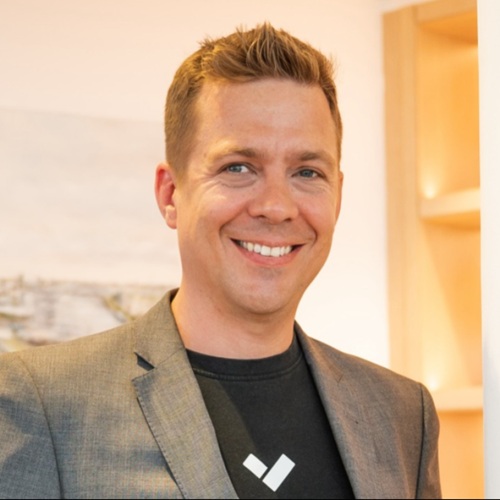 Benjamin Krebs, Country Manager DACH, Verkada
“Transportation covers everything that is mobile, from trains to ships and solutions for logistics providers,” said Krebs. “End users can now integrate their in-vehicle security with the infrastructure that covers their premises. This unlocks great benefits. Every scene of in-vehicle footage is, for example, linked to the GPS coordinates of where the vehicle was at the time, enabling operators to get full situational awareness.”
“Sound Systems follows a similar logic: We’re seeking to expand into fields where our existing customers have needs that can be integrated,” he added. “Manufacturers, logistics providers, retailers and schools all have public address systems, and they’re often outdated and a form of shadow IT that make their systems vulnerable. By integrating their sound infrastructure with Verkada, they elevate them to the same level of cybersecurity and privacy protection as their video security, access control, intrusion alarms, etc.”
DACH market specifics
In the three countries that Krebs is responsible for, privacy protection and data sovereignty play an outsized role. “Cloud reluctance” and the mistaken belief that data is safest if stays in an NVR locked away in a server room, however, no longer dominate the conversation. If the cloud vs. on-prem discussion comes up, though, Verkada addresses it proactively.
“The first thing that’s important to say is that we have a hybrid cloud architecture,” Krebs said. “Footage that is recorded and stored stays on the devices themselves, which stays with the customer. Management and access run through a highly secure cloud platform.”
“Classic, server-based architectures are often centered on a user profile that is shared among everyone involved with security operations. With us, every member of the team has their own credentials,” he explained. “Everything is logged in an audit trail that can’t be manipulated.”
“DACH-based users have oversight about where their data is being handled and stored—always on cloud servers in the EU,” Krebs stated. “Data transmission to and from the cloud is encrypted, as is data storage in the cloud.”
In DACH as elsewhere, security and IT teams have traditionally been operating separately. However, companies increasingly see the need to break down the boundary between physical security and IT, to simplify management and processes from procurement to maintenance, and ensure cybersecurity and data protection rules are applied evenly.
“We’re trying to help companies take this step,” Krebs said. “With Verkada, security devices become part of the IT infrastructure, not shadow IT, as is often the case with classic systems, some of which run on outdated software. With us, automatic patching keeps everything up to date.”
Establishing cloud as the technology of choice
Overall, Krebs sees Verkada well positioned in DACH, where cloud security has increasingly taken hold.
“In other areas of IT, cloud services have already become the norm,” Krebs explained. “I think a similar revolution is happening in security. In Germany, Austria and Switzerland, we’re not always the frontrunners in embracing new technology, but the benefits are too significant to ignore, and many organizations—the ones for which cloud security is most suitable—have already switched.”
“Cloud security is to some degree established,” he added. “For companies, it’s no longer about trying something new.”
Integration options
In this sense, Verkada fits its erstwhile description as a disruptor less and less. The emphasis Krebs put on integration options with the solutions of other vendors reflected that as well.
“About 90% of new customers we work with in DACH already have security systems in place. It cannot be anybody’s aim to force them to rip and replace infrastructure that’s working well,” he said. “Integration with legacy systems, for example existing IP cameras, is always part of these kinds of projects.”
“Central to the integration between Verkada and legacy devices is Command Connector,” Krebs added. “Those cameras become part of the Verkada ecosystem and can be operated from Command like all the other Verkada cameras. That unlocks new functions. Usually it makes the systems significantly more intelligent.”
“We’re a cloud-first company, which gives us a natural advantage over players who are gradually adding cloud options to their portfolio,” he said. “On the other hand, we do not put unnecessary, hard limits on what operators can connect. Take for example on-prem storage. Organizations whose internal rules call for a physical copy of their footage can run an RTSP stream in parallel to their local on-prem storage.”
Without forcing users to go all-in on new technology, Verkada remains ambitious.
“Our vision is to be the operating system for the physical world,” Krebs said. “I think we’re on a very good path, and our customers know the next innovation is always around the corner.”