Over the past decade, physical security has undergone rapid intelligent transformation, evolving from rule-based motion detection to deep-learning video analytics, and more recently to foundation model-enabled natural language search and system configuration. With the emergence of open-source sovereign AI agent systems such as OpenClaw and Hermes, Omdia projects that the $239 billion physical security equipment and services market is poised to enter the agentic AI era by 2027.
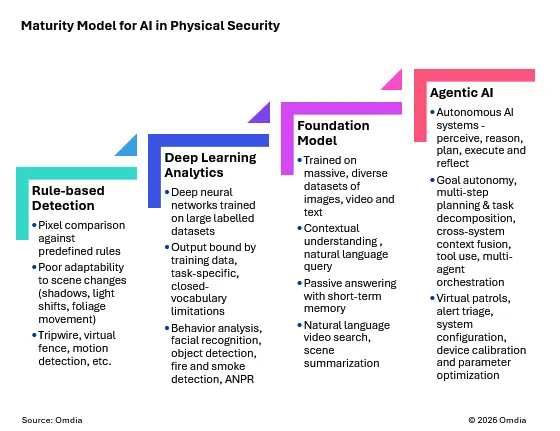
Unlike chatbots, which only react to human prompts, agentic AI can make autonomous decisions and trigger corresponding actions. Conventional physical security systems operate in a passive detection paradigm: they detect anomalies, raise alerts and hand off the burden of verification and triage to human operators. In contrast, agentic AI establishes a closed-loop "Perceive-Reason-Plan-Execute-Reflect" workflow. For instance, upon detecting an intrusion event, an agentic AI system can correlate alerts sourced from disparate subsystems — including video surveillance, access control, intrusion alarms and perimeter detection — into a single incident. It then analyses contextual metadata to assess alert validity and risk severity, tracks suspects across camera feeds, locks down designated zones, dispatches notifications to security personnel, and compiles compliance-ready incident reports.
While Agentic AI offers significant potential for autonomous workflows, enterprise adoption remains at an early stage. Today, the most practical deployments center on use cases built around well-defined standard operating procedures (SOPs). Agentic AI can deliver operational benefits for repetitive SOP-driven tasks such as automated virtual patrols, alert triage, system configuration, device calibration and parameter optimization. Successful implementations will strike a balance between total cost of ownership and the operational value unlocked by automating these repetitive tasks. As Model Context Protocol (MCP) and Agent-to-Agent (A2A) frameworks mature, agentic AI platforms are gaining interoperability with external tools and the ability to coordinate across multiple specialized agents. In a multi-agent architecture, an orchestrator Agent coordinates a fleet of domain-specific agents (e.g., video analytics, access authorization, audio event triage, and SOP compliance) to execute real-time context fusion. This architecture has the potential to meaningfully reduce false positives while enabling parallel, autonomous response workflows.
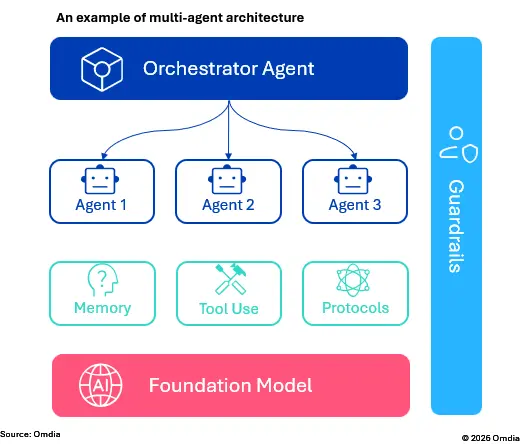
Given the mission-critical and safety-sensitive nature of physical security, the agentic AI rollout lags broader enterprise IT adoption, largely due to persistent concerns around operational reliability and safety. AI agents remain susceptible to unplanned or unintended actions. Organizations must establish enforceable guardrails that define clear boundaries for agent access, configuration modification and actuation capabilities. Industry best practices advocate for a Human-in-the-Loop (HITL) framework, positioning Agentic AI as a force multiplier that automates context synthesis while reserving high-stakes operational authorization to human operators. Evidence integrity is another critical consideration. Rather than delivering only condensed conclusions to operators, agents must retain complete structured evidence packets, including object classification, confidence scores, camera identifiers, timestamps and annotated frames, to support robust human decision-making and audit trails.
The transition toward Agentic AI is driving a structural realignment across the entire physical security value chain, with distinct implications for each class of stakeholder:
- End Users & SOC Operations: Agentic AI serves as a contextual triage engine, suppressing nuisance alerts and converting raw telemetry into actionable incident dossiers. This substantially reduces alert fatigue and shortens Mean Time to Respond (MTTR), though it does not eliminate the need for human oversight on high-stakes decisions.
- Hardware & Software Vendors: The industry is moving away from selling isolated devices or static licenses. Technology providers will increasingly need to consider expanding their portfolios toward open agentic platforms and interactive IoT devices equipped with standardized APIs and governance controls, enabling agents to safely perceive and interact with physical assets.
- System Integrators & VARs: Integrators may need to evolve beyond traditional hardware installation towards software solution architecture. By designing custom agentic workflows, orchestrating API integrations, and can create opportunities for recurring service revenue.
The transition toward Agentic AI marks a fundamental shift in physical security—from passive detection to dynamic, context-driven autonomy. As standards like MCP and A2A mature and multi-agent architectures take root, physical security systems will no longer just observe and alert; they will actively reason, adapt, and orchestrate real-time protection. As vendors, integrators and end users learn to calibrate agent autonomy within clear risk boundaries, agentic AI will gradually transition from an experimental concept toward a foundational layer for modern physical security operations.