http://www.asmag.com/Rankings/security50_taiwan2013.aspx

Ten Years Later: The Rise and Transformation of an Industry

Source: a&s International | Date: 09/09/2011

 Related tags: 911, R&D, security, IP

On September 11, 2001, four suicide attacks carried out by terrorist group al-Qaeda claimed nearly 3,000 lives and billions of dollars in damage, leaving the world in utter shock in the months and years that followed. Aside from the economic and political ramifications, one significant impact of the attacks was how profoundly life was changed for much of the world's population. Fear, and many other considerations, spurred massive investments in security. The security industry saw rapid growth, and overall awareness increased significantly among the general public. Today, 10 years after the 9/11 attacks, security has grown to be a multibillion-dollar, recession-resistant industry that is highly competitive and is redefining itself in many ways. Armed with funding from both the public and private sectors, the security industry was able to develop new and innovative technologies in the early 2000s. Although the 2008 recession significantly shrunk VC investments in R&D, innovation has not completely come to a halt. The advent of IP-based systems and its accelerating adoption have enabled some exciting new possibilities that deliver more for less to end users, and the movers and shakers of this industry, new and old alike, are now anticipating easier-to-use, smarter, single platforms that could manage and dictate security, building and many other systems simultaneously.

The 9/11 attacks were significant in that they were much more like an act of war, even though it was not conducted by a state actor as it traditionally is, said David Olive, Principal of Catalyst Partners. “It had very deep impacts on the economy and on a general sense of security. It is an event that one remembers throughout his or her lifetime, much the same way as one remembers the first time humans stepped foot on the moon.”

A direct effect of the attacks was the formation of the US Department of Homeland Security (DHS) one year later, in November 2002. Tens of billions of dollars were budgeted for the DHS, mainly allocated to first responders and disaster control. However, a hefty amount was also poured into the security industry through government projects or R&D funding.

In the early 2000s, there was a lot more innovation due to the resources dumped into R&D by venture capitalists and various governments, which aimed to adapt existing technologies to be used for homeland security purposes, said Dilip Sarangan, Research Team Leader for Physical Security, Frost & Sullivan. “Many new concepts and products emerged during that period. VCA, DVRs and IP-based security systems are just some examples.”

Almost from the very beginning, the Science and Technology Directorate of the DHS put out to the private sector a high-tech needs list. At the time, it was led by retired US Navy rear admiral Jay Cohen, who brought over some Department of Defense processes where they identified needs, put out announcements to the private sector and funded development of that technology, Olive said. “Resources were put into development of a wide spectrum of technologies, such as biochemical detectors, sensors, biometric systems and integration of disparate databases for easier information sharing. The DHS was very strategic in these investments in that they looked for technologies that potentially had a commercial market.” Over the past 10 years, communications between agencies have increased drastically in an effort to prioritize shrinking budgets, said Monica Heyl, CEO of Monica Heyl & Associates. “Technologies that can be reliably applied across different scenarios are what we can expect to happen more and more.”

Maturing Technology
Many of the technologies developed during that period have matured significantly in terms of commercialization. VCA, for example, was a technology that was little understood 10 years ago, Sarangan said. “Now, it's something end users do understand. They understand its capabilities and limitations, and that it is valuable to an organization when used for clearly defined functions.”

Funding from organizations like the DHS has undoubtedly played an important role in establishing and developing the market for physical security. It has led to technology innovation and increased sales, said Jon Cropley, Principal Analyst for Video Surveillance and VCA Research Group, IMS Research. “Government spending (not including education, retail or transportation) accounted for around 15 percent of the global market for VCA in security and business intelligence applications in 2010.”

In spite of this, the market for video analytics has not grown as quickly as many expected. Reasons include installation problems, false-alarm rates, lack of clear market education and the global economic downturn, Cropley said. “As the global economic environment improves, analytics providers are working hard to address these other issues. As they do, the market for VCA is forecast to grow steadily. Continued funding has provided the firm footing on which this market growth will be built.”

Another example is the proliferation of IP-based security systems. The introduction of networking has been the most revolutionary element in modern security systems, said John Moss, CEO of S2 Security. Putting it all on the network simplifies data transmission and eliminates all infrastructure costs that might be required of an analog system, Sarangan said. “This is definitely a market where there is a lot of potential. It has applications mostly in government and critical infrastructure installations, but some of those applications also benefit large organizations and make a lot of sense to use in the commercial world as well.” [NextPage]

Integration
With the advent of IP-based security solutions, integration and interoperability have improved significantly. Integrating security systems with other subsystems in a building is starting to become easier now that the same protocol and common platform can be used, Sarangan said.

This has, in part, led to a major change in the way security is approached. Traditionally, building automation, HVAC and other systems were always integral in the original design of the building, and were factored into the whole design in very early stages. Security was almost always looked at afterwards, and was something that people did not consider until after the building was constructed, Sarangan said. “Now, people are beginning to give security the same priority as they give building automation systems. They are starting to realize that security systems should be a part of the initial design and should be connected to the building during construction.”

It will take a while before it happens everywhere, but that is one thing that has changed over the past few years and will continue to gain momentum, Sarangan added.

New Players
Players in building automation have been playing a bigger role in security for obvious reasons. It fits well into their business strategy in that integrating security into their systems provides more value for their customers. After the 9/11 attacks, a lot of end users were in very unique situations where they had to provide levels of security that they did not typically provide in their buildings or businesses, said Andre Greco, Director of Sales for Security and Fire in North America, Johnson Controls. “Customers wanted to increase security to the point where they knew that only authorized individuals were getting into certain areas or into the building in general. We saw a lot of increased needs for turnstiles in high-rise, multitenant environments. There was also more demand for formalized visitor management processes and more in-depth vetting of individuals that were coming into the building, especially in major metropolitan areas.”

There has also been increased demand for securing areas that are wide open and see a lot of public access. Previously, security systems were focused on battling petty crimes such as theft or vandalism, Olive said. “Now, with the new terrorism overlay, areas that typically would not have security need new solutions to meet these new requirements.”

Building automation tends to look at the building from a different perspective. “When convergence became a hot topic seven or eight years ago, we started to see that almost everything low-voltage, critical or noncritical, within a building would be run across the network. We knew that it was a situation where IP was quickly going to become very prevalently,” Greco said.

Changes
One effect of the convergence between IT and physical security is a change in mentality. For some companies, network cameras are procured through the physical security department, and yet it is becoming more common for the IT department to make these decisions, Moss said. “The two departments are not as far apart as they used to be. The people I would see 30 years ago in security were almost always from law enforcement, whereas today I see people in physical security that actually came from IT backgrounds.”

Integration companies more well-known in the IT world have contributed to the industry as well, helping installers and end users cope with IP-based video surveillance. “They let people know that it's OK to put video over your network and store video with HDD-based storage solutions, and that it's necessary to have redundancy for video applications. They've helped companies understand that video is here to stay and that it's just another type of data. As it becomes more and more IP-based, it's going to fall under the realm of the IT department, and companies such as Cisco and Anixter have helped the IT community from that standpoint,” Greco said.

Even though the security industry migrates more slowly than most other industries, there have been changes over 10 years; however, it is hard to determine whether those changes were caused or only influenced by 9/11, Moss said. “Most of the changes I've seen in the industry are related to changes in the general economy, so the rate of change in the industry might be a little higher than normal because of the influence of IT on physical security. The overall rate of change has not been particularly caused by 9/11.”  [NextPage]

Awareness
We live in very dangerous times, with far more threats than previously imaginable. Kids that do not know anything about biology and chemistry can search the Internet and find recipes to make very dangerous biochemical reagents, Heyl said. “They can buy and make these with little cost, and this has created a situation where one individual can go out and do significant damage to a lot of people. This makes it difficult to keep under control these people and government radicals who live on the outside of society. The world has become a much more dangerous place.” The recent tragedy in Oslo is just another example.

The attack could have been prevented had the Norwegian authorities been more vigilant, said Joshua Sinai, Associate Professor, Center for Technology, Security and Policy, Virginia Polytechnic Institute and State University. “As an extremist, he should have been known to the authorities, identified through data mining and behavioral analysis. Once identified, he could be flagged as a potential threat and properly monitored after legal procedures.”

The increase of threats has made people more aware of their surroundings than ever before, especially when it comes to traveling. Governments are continuously educating the public to take note of anomalies and report them to the authorities. Consistent audio messages and visual reminders have people constantly aware of their surroundings, Greco said. “There are a lot of campaigns just to keep awareness high that if you see something, you need to say something. This is so that the public does not become complacent, or forget about what happened 10 years ago; we need to continue to have a heightened sense of awareness to potential risks.”

Furthermore, with the advances in global communications, significant events rarely go unnoticed. “We are living in a globalized world and in increasingly open societies, which are characterized by the interconnectedness through new media,” said Gert van Iperen, Chairman of the Board of Management, Bosch Security Systems. “Whenever a national disaster, a violent revolution or a terrorist attack takes place, the entire world gets informed about it immediately. People all over the world watch live, with ongoing pictures provided by the mass media.”

Homeland security is now increasingly regarded as personal responsibility, which was generally not the case pre-9/11, Olive said. “However, there is still a lot of education that needs to be done as to what people can do to protect their life and lifestyle. While the general public is much more resilient against these attacks, we are not yet where we need to be.” Unfortunately, many corporations still view security as an unnecessary expenditure. They do not realize that this is an investment that will be returned within several quarters, said Anthony Roman, CEO of Roman & Associates, an investigation, security and risk management consulting firm. “If security technology and the security department were coupled with corporate risk management, which is responsible for assessing accidents and incidents, as well as economic losses to crime and internal theft, savings could be made on insurance claims, tort liability losses, damage to corporate branding and regulatory fines.”

Riding Recession
The security industry has grown significantly over the past 10 years. Despite the 2008 recession and weak recovery, the market for security electronics has continued to grow, albeit at a slower pace, Sarangan said. “Obviously, customers do not have the same capital to invest in security, but the industry was still growing at 5 to 6 percent per annum even over the past three years.” Compared to other industries, ours did remarkably well and is currently proving to be recovering quickly, van Iperen said.

While many regard the security industry as “recessionproof,” it is a notion that remains a myth. There is no such thing as a recession-proof industry, Sarangan said. “When budgets are shrinking and customers can no longer afford it, they simply will not purchase. The security industry was growing at a decent rate even through the recession, but that's about as recession-proof as it gets.”

Nevertheless, countries that are more under the threat of terrorism continue to see hefty government spending in security, Sinai said. “They're purchasing a lot of counterterrorist and public-safety equipment. That is a new market and huge opportunity for technology companies.”

Striving to Innovate
One reason why it remained growing through the recession was it began to deliver more value to end users. “The industry has been innovative both technically and commercially and has produced better products at lower prices that deliver on ROI; this is why buyers are investing in new systems, said Allan McHale, Director of Memoori Business Intelligence, in a prepared statement. “This is why IP networking products have pushed ahead with a forecast growth of 35 percent this year. Those companies that have focused on IP network products have increased their market share and at the same time have increased their profitability.”

Many larger companies took a big hit through the recession, but overall growth in the security industry was maintained by a lot of new and smaller companies, Sarangan said. “In addition, many companies coming from the IT sector have been doing pretty well over the past few years. The hit to larger companies was mainly offset by the growth of these smaller companies and IT companies, which had a lot of growth within the security world. Over the past few years not only IT, but building automation and building management companies also made a play in security and saw pretty good growth.”

An advantage of these newcomers was that they were experienced in more than security. The impact of the recession was minimal for Johnson Controls because for the past three years, customers have been looking for solutions that increase efficiency and productivity, as well as reduce costs. “It makes sense for them to continue to invest because of a solid ROI model,” Greco said.

Bigger companies see security as a growth opportunity, and they are trying to expand their product lines to be able to provide more value to customers. “They have the resources to expand their offerings in a tremendous growth industry where nobody has an overwhelming market share,” Greco said.

This actually drives innovation in the industry. Larger companies generally do not innovate their products, Moss said. “The smaller, private ones innovate their products but have less resources. The normal flow for the past 30 years has been that entrepreneurs create innovative companies and products, which are ultimately purchased by much larger entities that have the capital and infrastructure to grow them.” Although innovation has slowed as a result of less money invested in R&D mainly due to less venture capital spending, it has not stopped altogether. “Things like VMS are becoming more commoditized, but there is still a big market for good, quality management software that manages surveillance and control systems,” Sarangan said. “Another example of innovation through the recession is PSIM. This is definitely an innovation that adds great value for the end user.”  [NextPage]

Crystal Ball?
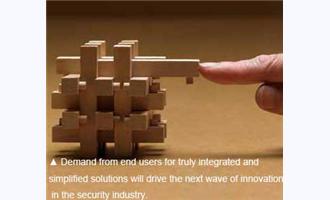
The next big thing for the security industry will probably be more effective and seamless integration. “A major innovation we expect to see in the next few years is some type of solution, perhaps a software product, that actually can integrate any and every product into a single solution. We will definitely see those products within the next few years,” Sarangan said.

Security is really headed toward integration of multiple systems onto a single platform, and system integrators will find it easier to integrate these products, which ultimately benefits the end user, Greco agreed. “Stand-alone systems and disparate technologies are going away quickly as companies continue to produce products based on an open platform.”

Admittedly, there are still hurdles to overcome before this can be realized. There are still companies using proprietary technologies, and are not willing to share APIs or SDKs with other companies so that integration can be accomplished, Greco added. “However, it is certainly a lot further along than it was as little as three years ago. This is really driven by customer demand, as they expect their systems to be integrated on a single platform. The IT industry has been doing integration for 25 years, and integration will become more relevant as security becomes increasingly IT-driven.”

Cloud computing for security applications will mature in two to five years, Greco said. “While there are concerns over information security, current issues will be resolved and the market will mature. One big benefit is the ability to store data in the cloud rather than maintaining storage on-site.”

Identity management is another technology that is not very common today but will become very common in five to 10 years. “This is a concept that end users could really take advantage of in their businesses, and we will start to see that technology become widely deployed when end users are installing or upgrading their access control systems,” Greco said. “Not many companies today offer software that allows human resources information to abide by a set of predetermined policy, which in turn creates an access profile for a card holder and exports that profile into the access control database. The benefit is complete elimination of manually setting up an access control database and managing changes with that access control database.” The integration of human resources, policy engine and access control will become the norm.

More than anything, the 9/11 attacks increased the scale and brought focus to an industry that was previously scattered and diffused, Olive said. Future developments will continue to see convergence and integration of disparate systems, as this is clearly what end users are demanding.

Integrated, interoperable and holistic solutions are the further evolution or development of the industry, van Iperen said. “Let's take the integration of fire detection and evacuation systems as an example. This combination has been in increasing demand from the market side for some years now, with good reason: Both systems strengthen each other and reinforce safety and security.” And it does not necessarily mean that products will become more expensive to purchase or more difficult to use.