With hundreds of manufacturers to choose from and little comparative information available, choosing the "right" surveillance camera can be difficult. Worse yet, specifications provided by manufacturers are often unhelpful or misleading.
With hundreds of manufacturers to choose from and little comparative information available, choosing the "right" surveillance camera can be difficult. Worse yet, specifications provided by manufacturers are often unhelpful or misleading.
There are four questions to consider when choosing surveillance cameras, all of which address the current lack of standards in video surveillance:
* How well does the camera work in low light?
* How well does the camera work in bright sunlight?
* How much detail does the camera provide?
* How hard is it to configure the camera for optimal image quality?
Handling Low Light
.jpg) As critical as low-light performance is for many security applications, it is also difficult to assess. While numbers are provided, they are not to be trusted. First, everyone measures low-light performance slightly differently, making it difficult to compare. Secondly, most manufacturers only include partial information. Third, there is no standard or definition of what an acceptable image is, leaving this up to the subjectivity of the manufacturer. Therefore, if you are trying to assess low-light performance, throw these numbers out, and do a test yourself in the location you want the camera to be deployed.
As critical as low-light performance is for many security applications, it is also difficult to assess. While numbers are provided, they are not to be trusted. First, everyone measures low-light performance slightly differently, making it difficult to compare. Secondly, most manufacturers only include partial information. Third, there is no standard or definition of what an acceptable image is, leaving this up to the subjectivity of the manufacturer. Therefore, if you are trying to assess low-light performance, throw these numbers out, and do a test yourself in the location you want the camera to be deployed.
Dealing with Bright Sunlight
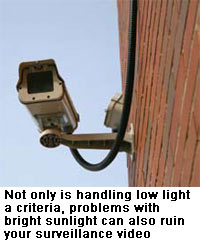
Problems with sunlight are not limited to outdoors. Anytime you have windows or doors that open to the outside (obviously very common), you are at risk to issues with bright sunlight ruining your surveillance video.
Cameras designed to address this are wide dynamic range (WDR) cameras. However, comparing the specifications of various WDR cameras is difficult. Often, cameras labeled WDR have no technical specifications, and those that do usually measure the range in dBs. However, it is not clear how much better an image is created with a 100-dB range than a 60-dB range.
 Seeing Details
Capturing details of a scene is critical in determining if your camera meets its security objective, and it is also increasingly important for reducing camera count. The stated resolution of a camera is better viewed as the pixel "potential" than the definite resolution you will obtain. Also, with special concern for megapixel cameras, not all megapixel cameras, even those rated for the same pixel count, will deliver the same level of detail.
Determining Configuration
Cameras at trade shows or from manufacturer-supplied demos almost always look outstanding. This happens because manufacturers have technical experts who know all the camera's configuration options and have significant experience experimenting with various combinations of settings (including lighting conditions).
As such, determining how well cameras work "out of the box" is important. If a camera's image quality can only be made to work well with adjusting multiple settings, the risk of performance increases.